
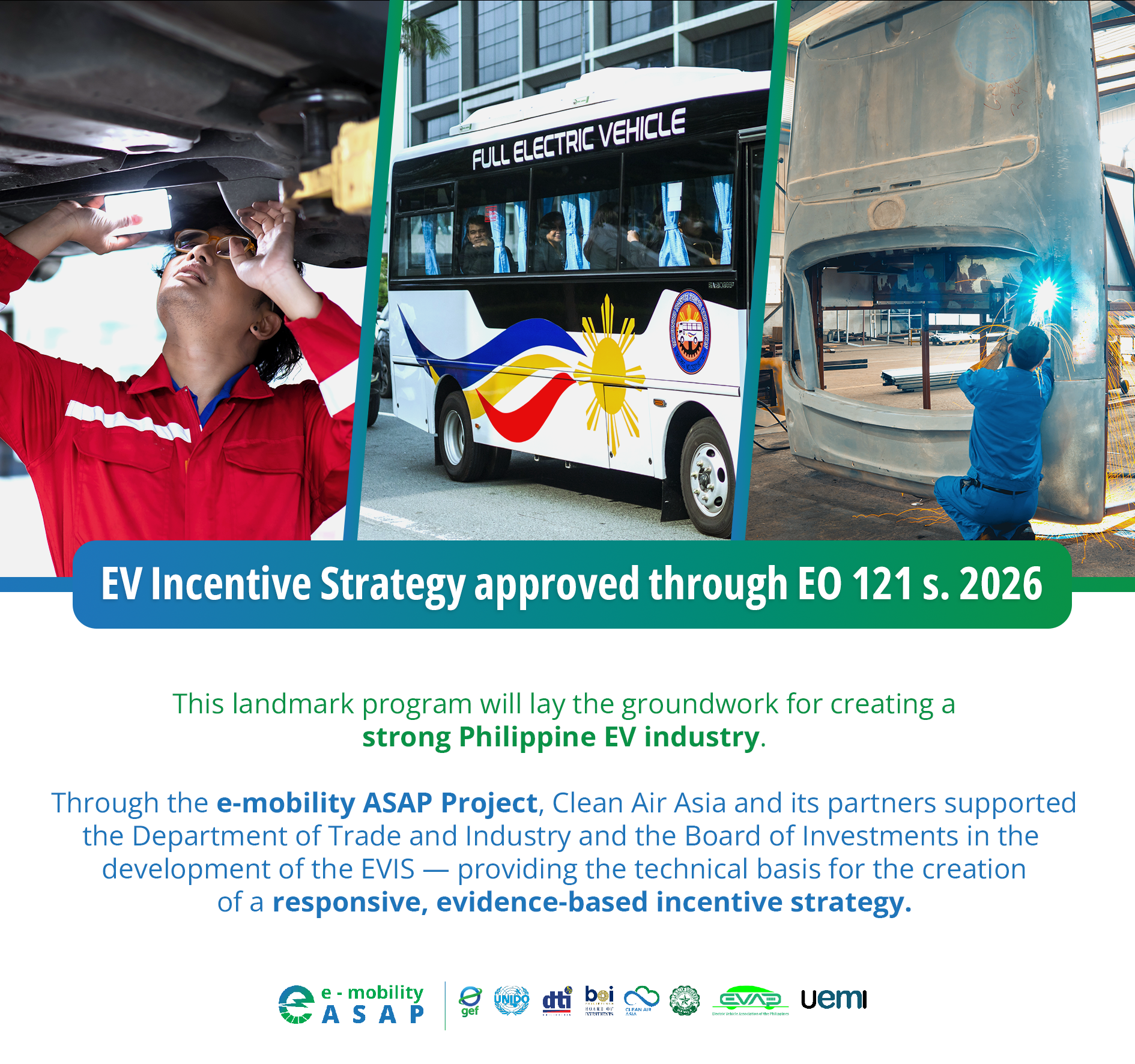
Approved EV Incentive Strategy marks milestone for Clean Air Asia-led e-mobility ASAP Project and Philippine e-mobility transition
Clean Air Asia welcomes the signing of the Executive Order (EO) 121 series of 2026 providing for the Electric Vehicle Incentive Strategy (EVIS) Program as a major milestone in the Philippines’ transition toward a cleaner, more sustainable, and more competitive transport sector.
“The EVIS helps translate years of technical work and stakeholder engagement into a clearer pathway for accelerating electric mobility in the Philippines. Clean Air Asia is proud to have supported government and industry partners in strengthening the evidence base for policies that can advance low-carbon transport, improve air quality, and deliver more sustainable mobility solutions for Filipino communities,” said Bjarne Pedersen, Clean Air Asia Executive Director.
The EO signed by President Ferdinand Marcos Jr. on July 29, 2026 marks a significant step forward for the country’s shift to electric mobility in the transport sector. Moreover, it is a recognition of the contributions of the Global Environment Facility (GEF)-funded e-mobility ASAP Project where Clean Air Asia serves as consortium lead among the Project Executing Entities, in supporting the development of enabling policies and programs for electric mobility in the Philippines. The Project, implemented by the United Nations Industrial Development Organization (UNIDO) with the Department of Trade and Industry (DTI) and the Board of Investments (BOI), has been providing support to the development of the EVIS as one of its central activities.
The strategy aims to accelerate the country’s transition to electric mobility by narrowing the cost gap between electric vehicles (EVs) and traditional motor vehicles, supporting the shift of the local automotive industry toward EV production, and providing targeted fiscal incentives to attract investments in the manufacture of hybrid and battery EVs, specifically passenger cars and commercial vehicles, including their parts and components.
The signing of the EO represents the culmination of years of collaboration among government agencies, development partners, industry stakeholders, and civil society organizations through the e-mobility ASAP Project to accelerate the country’s transition toward low-carbon transport systems.
Through the development of the EVIS, Clean Air Asia and its consortium partners, De La Salle University (DLSU), the Electric Vehicle Association of the Philippines (EVAP), and the Urban Electric Mobility Initiative (UEMI), have worked closely with the DTI and BOI to provide the technical, legal, and economic basis for the creation of an evidence-based incentive strategy. This included detailed policy and regulatory reviews, macroeconomic analysis, EV market and value chain assessments, analysis of opportunities and gaps in local EV and EV parts manufacturing, and consultations with government, industry, academe, and transport stakeholders.
While the EVIS will help create the conditions for a stronger local EV industry, the broader work of the e-mobility ASAP Project helps translate this policy direction into practical gains for the e-mobility industry as a whole. Complementing the supply-side policy interventions of the EVIS, the Project continues to increase the knowledge base for local EV manufacturing through its research and consultation initiatives. In addition, through efforts to encourage demand by supporting financially accessible business models, charging infrastructure planning, capacity building, and deployment activities, the Project helps make electric mobility more viable for transport service entities. These efforts also support the just transition toward cleaner and more reliable public transport systems. In turn, this can help improve transport services and outcomes for both drivers and commuters.
With the transport sector being among the major contributors to air pollution in the country, the local manufacturing and wider adoption of electric vehicles can help reduce greenhouse gas emissions and improve urban air quality, while supporting more energy-efficient and sustainable transport systems for Filipino communities. By accelerating EV adoption through local manufacturing, the EVIS is also expected to contribute to the country’s commitments under the Paris Agreement and its Nationally Determined Contribution (NDC), which targets a 75 percent reduction and avoidance of greenhouse gas emissions by 2030.
This comes at an opportune time as air pollution continues to be a serious health risk, with more than 99,000 deaths in the Philippines attributed to air pollution in 2023 according to the State of Global Air 2025 Report.
The EVIS will be an essential launchpad in the transition to electric mobility and establishment of a strong local EV industry. Based on analysis by the e-mobility ASAP Project, there are many areas where future government support could be directed including expanding the coverage of incentives to the wider EV ecosystem, such as with light EVs (LEVs), charging equipment manufacturing, and infrastructure for vehicle and parts testing and validation.
Moving forward, Clean Air Asia, through the e-mobility ASAP Project, continues to support the implementation of the EVIS. The Project will also continue its ongoing initiatives in driving the shift to electric mobility, while supporting the Philippines in achieving its air quality, climate, and sustainable transport goals.
“The passage of the EVIS is only the beginning of the work ahead to build a robust and inclusive electric vehicle industry in the Philippines. This milestone would not have been possible without strong multi-sectoral collaboration toward a shared vision for sustainable mobility. With effective implementation, the EVIS can create green jobs, contribute to cleaner air, and improve the quality of life for Filipino communities. Clean Air Asia, through the e-mobility ASAP Project, will continue working closely with our partners to help turn this vision into reality sooner rather than later,” said Atty. Glynda Bathan-Baterina, Deputy Executive Director of Clean Air Asia.
---
About the e-mobility ASAP Project
The e-mobility ASAP Project, or the “Accelerating the Adoption and Scale-up of Electric Mobility for Low-Carbon City Development in the Philippines” Project, is funded by the Global Environment Facility (GEF) and implemented by United Nations Industrial Development Organization (UNIDO) with the Department of Trade and Industry (DTI) and the Board of Investments (BOI). The Project is executed by Clean Air Asia with consortium partners De La Salle University (DLSU), the Electric Vehicle Association of the Philippines (EVAP), and the Urban Electric Mobility Initiative (UEMI). The Project supports the Philippines’ transition to low-carbon transport by accelerating EV adoption and strengthening the local EV industry and enabling ecosystem.
